Preloader Close
WHAT WE OFFER

OUR DESIGN SERVICES

Design includes the preparation of conceptual, main, and detailed construction projects for all types of buildings—in accordance with applicable laws, technical regulations, and the investor’s requirements. Throughout this process, we align functionality, aesthetics, and budget, while coordinating all disciplines to ensure the project can be executed efficiently and safely.

Before the design process begins, we analyze the potential and constraints of the site — including urban planning conditions, access, orientation, utility infrastructure, and other key factors. Through technical consulting, we help investors make informed decisions about the scope, type, and phases of the future project.

The concept design is the first step in shaping the project — where we explore the possibilities of the site and the needs of the investor. Based on this, we define the basic concept of the building’s appearance, function, and spatial organization. Using the concept design as a foundation, we initiate the process of obtaining the necessary conditions (special conditions and utility connection requirements) from the relevant authorities. These form a key basis for the further development of the project and the preparation of documentation for the building permit procedure, as well as for the preparation of the conceptual project.

The conceptual project serves as the basis for obtaining a location permit and, for less complex structures, a building permit. It represents the further development of the concept design into official project documentation. Based on the obtained special conditions and utility connection requirements, it defines the building concept (purpose, dimensions, placement on the plot, spatial organization, and key technical solutions), while ensuring the documentation complies with spatial planning regulations and applicable laws. If a location permit is required, the conceptual project serves as the foundation for determining location conditions and confirming that the planned development complies with the spatial plan. It is then used as the basis for the further preparation of documentation required for the building permit.

The main project represents a comprehensive and coordinated technical solution for the building, encompassing the designs of all relevant disciplines and demonstrating compliance with essential requirements. It is the primary documentation used for supervision during construction, ensuring that all work is carried out in accordance with regulations. It is also crucial in the process of obtaining the occupancy permit: a copy of the main project must be submitted with the application, and during the technical inspection it is verified whether the building has been constructed in accordance with the approved main project.

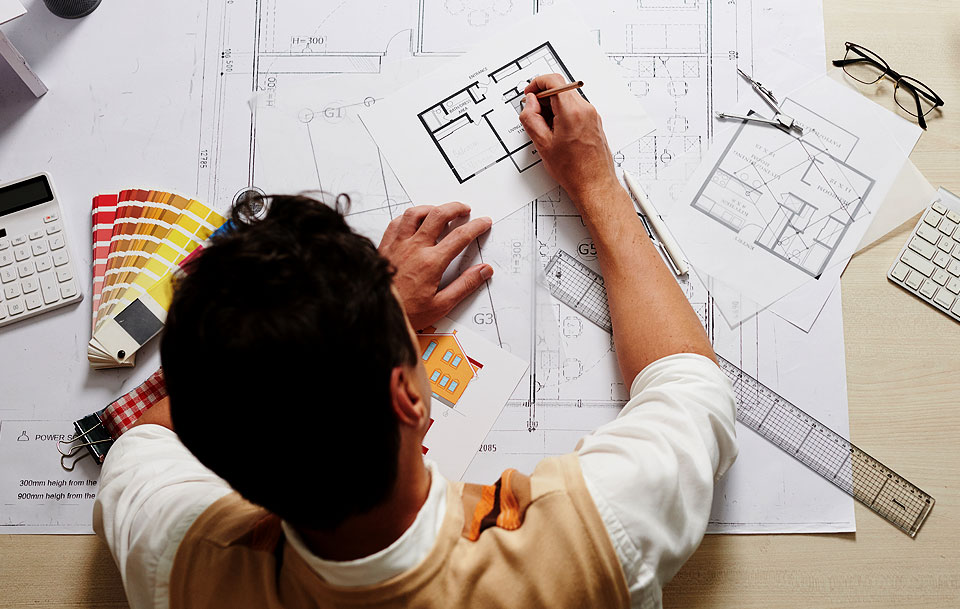
The detailed design project is a more precise elaboration of the main project intended specifically for the construction site. It includes graphical drawings and technical details necessary for accurate execution. Its purpose is to provide contractors with clear, step-by-step instructions—what is to be done, where it is done, and how—so that construction works can proceed more efficiently and with fewer errors.

We prepare all the necessary documentation required for obtaining a building permit, in accordance with applicable regulations. We coordinate all participants involved (designers from different disciplines) and ensure that the documentation is complete, properly organized, and ready for submission to the relevant authorities.

During the design phase, we consider the building’s energy performance, energy consumption, and the selection of heating, cooling, and ventilation systems. The goal is to ensure comfortable living conditions while reducing operating costs and complying with energy efficiency regulations.

BIM modeling enables the creation of a detailed 3D model of a building that integrates all disciplines—architecture, structural design, installations, and equipment. Instead of traditional 2D drawings, the investor and contractor receive a clear spatial representation of the future building, with the ability to review solutions even before construction begins.

Through BIM, potential clashes between installations and structural elements can be identified more easily, technical details can be resolved in advance, and construction phases and costs can be planned more precisely. This approach reduces the risk of on-site changes, speeds up execution, and provides better insight into the project throughout its entire lifecycle—from the initial concept to the building’s maintenance.

Lorem ipsum dolor sit amet, consectetur adipiscing elit. Nulla sit amet venenatis dui. Nullam convallis rhoncus enim, in dapibus est pretium in. Quisque id enim dignissim, laoreet mauris nec, molestie nulla.

  • Lorem ipsum dolor sit amet, consectetur adipiscing elit?

    Nulla sit amet venenatis dui. Nullam convallis rhoncus enim, in dapibus est pretium in. Quisque…

  • Lorem ipsum dolor sit amet, consectetur adipiscing elit?

    Nulla sit amet venenatis dui. Nullam convallis rhoncus enim, in dapibus est pretium in. Quisque…

  • Lorem ipsum dolor sit amet, consectetur adipiscing elit?

    Nulla sit amet venenatis dui. Nullam convallis rhoncus enim, in dapibus est pretium in. Quisque…

Our partners

A high level of quality control in accordance with national and international regulations and standards

A high level of quality control is the foundation of every project we undertake, whether it involves design, construction, or professional supervision. Our advanced 3D services using LiDAR technology enable precise capture of existing conditions and improved coordination among all project stakeholders. This reduces discrepancies, accelerates processes, and ensures full compliance with professional and technical standards.

Go To Top